Can you fine-tune Jev?
No. TypeSafe's Models page says Jev "is not fine-tuned or LoRA-adapted with customer data" and that the same weights serve every account, so you adapt it through the request (the state, your question wording and criteria) and through code (Models). If you need a model you can train yourself, community projects train their own Jev-style decision models on open base models, which are separate from Jev.
What TypeSafe's docs say
The Models page has a section called "Customizing Jev". It says Jev is trained with RLCD to return calibrated decisions and that you shape its answers "through the request rather than through per-account weights" (Models). RLCD, Reinforcement Learning for Calibrated Decisions, is TypeSafe's own post-training method; its goal is probabilities that match how often answers turn out right (AI primer).
The docs describe two endpoints, POST /v1/systemone for questions and GET /v1/models for listing models, and no training or fine-tuning endpoint (API reference, Models). TypeSafe also says Jev is not trained on customer requests or responses (Models), and its customer agreement says customer data will not go into a training dataset without the customer's consent (MCA).
How to adapt Jev without training it
The docs list three levers (Models):
- State. Put your own content, records and reference material in the
statefield. The docs advise against relying on knowledge in the model's weights when current information can come from your own data (How to build with TypeSafe). - Instructions and criteria. Write your domain rules and edge cases into each question. Both fields accept structured JSON, so you can add definitions and examples per option (Advanced: structure, How to build with TypeSafe).
- Decomposition. Split broad judgments into small questions and combine the answers in code with weights you control (Composite scoring).
For learned behavior, the docs suggest feeding Jev's probabilities into a classical machine-learning model. The AutoResearch cookbook turns wine-review text into Jev answers and trains a CatBoost regressor on them; its held-out error beat the same model reading word counts (AutoResearch cookbook). If you tune confidence thresholds, pin a versioned model ID such as jev-1.13.0, because the jev-latest alias moves when a new release ships (Models).
Some community tools automate the prompt side. Sutro's jev-align asks you to label uncertain examples, then uses GEPA to propose a better definition for the function, not new weights (jev-align on GitHub). See how to use Jev for the basics.
What the terms say about training on Jev's output
TypeSafe's Master Customer Agreement prohibits using the service or any output "to perform model distillation, train a model to imitate the output of the Services, or develop (or to facilitate the development of) a similar or competing product or service" (MCA).
That is different from what the AutoResearch cookbook shows. There, Jev's answers are features for a separate model that predicts your own labels. It is not a copy of Jev. This page is not legal advice; read the agreement before you train anything on Jev's answers.
How community projects train Jev-like models
Independent developers have built models with Jev's interface (a state, typed questions, one probability per option) from open base models. None of these are Jev, and none are affiliated with TypeSafe.
- Train a small scorer from scratch. Jevlike's README gives a JSONL format of context, options and the correct label, plus commands to train, evaluate and predict. An optional path keeps a pretrained encoder frozen and trains only the small scorer (Jevlike on GitHub).
- Fine-tune an open LLM. The decider README describes 2B, 4B and 35B models built on Qwen3.5 base checkpoints. It trains on public datasets plus labels from a local Qwen teacher model, and says "nothing was distilled from Jev" (decider on GitHub).
- Build the whole pipeline. JevForge covers data synthesis, training and calibration, evaluation, and serving through a Jev-compatible API (JevForge on GitHub).
Their benchmark numbers are self-reported. You can compare them with other independent evaluations under benchmarks and research. For local models you can run without training, see open source Jev alternatives.
Projects doing this
 Benchmarks & researchJevlikeAn independent training starter for a small model that scores a changing list of text options in one pass, with Doom, chess and Wikispeedia demos.GitHub · ★ 1.3k · vinnylarouge
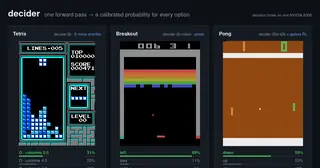 Benchmarks & researchdeciderSystem One-style models fine-tuned from Qwen3.5 for one-pass typed decisions with probabilities.GitHub · ★ 351 · Mapika
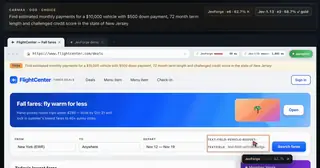 Benchmarks & researchJevForgeAn end-to-end Jev-style stack covering data construction, Qwen3.5-0.8B training, evaluation, preliminary RLCD and local serving.GitHub · ★ 35 · zwliJay
 Benchmarks & researchValenA project for training a Jev-like model yourself, with vision input added.GitHub · ★ 51 · Liuziyu77
 Benchmarks & researchreflexA small open decision model re-created on Qwen3.5 that takes a state and typed questions and returns probabilities.GitHub · ★ 133 · kshetrajna12
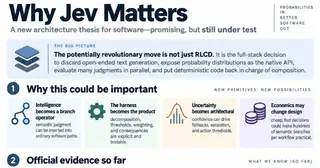 Benchmarks & researchVerdict-open-jevAn open 151M-parameter decision model on ModernBERT, with an in-browser WebGPU playground.GitHub · ★ 94 · Heman10x-NGU
 Benchmarks & researchopenjev on Qwen 4BAn MLP trained on top of Qwen 4B that works like Jev.Site · Alex Nikolic
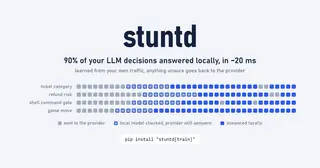 SDKs & integrationsstuntdA local proxy that records an app's typed decisions and learns to answer them with a small head on a frozen Laya encoder.GitHub · ★ 21 · bladedevoff
 Benchmarks & researchjev-align (Sutro)An active-learning CLI that uses human labels and GEPA to improve Jev question definitions instead of model weights.GitHub · ★ 284 · sutro-sh
 Data & extractionFeature discoveryTypeSafe's cookbook for turning written notes into features that train a separate classical model.Guide
Questions
Can I fine-tune Jev on my own data?
No. TypeSafe's docs say Jev is not fine-tuned or LoRA-adapted with customer data and that the same weights serve every account. You adapt it through the state, your question instructions and criteria, and code.
Does TypeSafe offer LoRA adapters or custom models for enterprises?
The docs describe no per-customer weights. Enterprise and custom plans are mentioned for higher rate limits and zero data retention, not for custom training.
Is Jev trained on my API requests?
TypeSafe says no. Its docs state Jev is not trained on customer requests or responses, and its customer agreement says customer data is not used to train models without consent.
Can I use Jev's answers to train my own model?
Using them as features for a separate model that predicts your own labels is what TypeSafe's AutoResearch cookbook shows. Training a model to imitate Jev's output, or to build a competing product, is prohibited by TypeSafe's Master Customer Agreement.
How do I train my own Jev-like model?
Start from a community project such as Jevlike, decider or JevForge. They train on public or synthetic data from open base models. They are independent of TypeSafe and publish their own results.
More guides: What is Jev?Jev pricing and API costJev vs LLMs: when to use whichHow to use Jev: a quickstartJev and MCP: using Jev as a Model Context Protocol toolHow to use Jev with Claude CodeJev in an agentic harness: where it fits in an agent loopJev for orchestration: routing requests, models and skillsJev as a judge: evaluating LLM and agent outputsJev for SEO and GEOJev for ads and ad reviewJev for marketing and lead scoringIs there an open source Jev?Designing questions for JevWhat is RLCD?Jev statistics