Is there an open source Jev?
No. Jev is a hosted model: TypeSafe serves it through its API, the same weights serve every account (Models), and we found no downloadable weights or self-hosting option in TypeSafe's docs or on its site. What is open is TypeSafe's client code, published under the MIT license on GitHub, plus a growing set of independent community models that copy Jev's input and output shape and run on your own hardware.
What TypeSafe keeps closed
Every TypeSafe model is served by one endpoint, POST /v1/systemone, and the request's model field picks the model. The current model is jev-1.13.0, priced per input token (Models). See Jev pricing for what that costs in practice.
The docs describe Jev as not fine-tuned or LoRA-adapted per customer: "the same weights serve every account" (Models). You can try it without code in the Playground (Jev with coding agents). At launch TypeSafe opened Jev in early access and said it was bringing developers off the waitlist as quickly as it could (launch post).
TypeSafe's Master Customer Agreement also bars customers from using the service or its output "to perform model distillation, train a model to imitate the output of the Services, or develop" a competing product (MCA). So an open copy trained on Jev's own answers is not something the terms allow.
If data residency is the reason you want a local model, TypeSafe says Jev is not trained on customer requests or responses, and it offers zero data retention to enterprise customers (Models, Legal).
What TypeSafe does publish as open source
TypeSafe's GitHub organization publishes four MIT-licensed projects for building with Jev:
- typesafe-sdk-python: the official Python client.
- typesafe-sdk-js: the official TypeScript and JavaScript client.
- skills: the agent skill that teaches Claude Code, Codex and other coding agents to write TypeSafe code.
- system-one-adapter-python: a drop-in replacement for the SDK's
system_onecall that is "backed by LLM APIs instead of TypeSafe".
The adapter is the closest official thing to a Jev alternative. Its README says it is for comparing TypeSafe against an LLM on cost, speed and intelligence. It supports OpenAI-compatible, Anthropic and Gemini providers, including a custom OpenAI-compatible endpoint. It returns a subclass of the SDK's response type, but the answers come from the LLM you pick, not from Jev. More clients live under SDKs and integrations.
Community open and local projects
None of the projects below are made or endorsed by TypeSafe. They fall into three groups:
- New open-weight decision models. Authors train their own model to take a state and typed questions and return probabilities. Laya has the most GitHub stars of the open decision models we list (about 23,800 on September 25, 2026); its README describes a multilingual, non-autoregressive decision engine installed with
pip install laya(Laya on GitHub). The decider README says it is built on Qwen3.5 base models and that "nothing was distilled from Jev" (decider on GitHub). - Wrappers around existing open LLMs. These read probabilities from a model you already run, with little or no training, and return Choice, Score and Noul-shaped answers.
- Compatible servers. These expose a local
/v1/systemone-style endpoint so code written for Jev can call an open model instead.
Treat their speed, accuracy and calibration numbers as the authors' own claims; we have not checked them. More independent model projects are listed under benchmarks and research.
Hosted Jev or a local model?
Jev's published limits are specific: text input only, a 64k-token context per request, English as the main training language, and rate limits that TypeSafe says are still changing (Models). TypeSafe also publishes a list of known weak spots for version 1.13 (Jev 1.13 jaggedness).
A local model keeps data on your machine and has no rate limit other than your hardware. In exchange, you own the serving, the updates and the calibration. Whichever you pick, do what the docs recommend for Jev: plot confidence against accuracy on your own data before you set thresholds (How to build with TypeSafe).
For background, see what Jev is, Jev vs. LLMs and Jev vs. classifiers. If you want to train a model yourself, read Can you fine-tune Jev?
Projects doing this
 Benchmarks & researchLayaOpen weights that answer typed questions in one forward pass, 33 ms on a T4 according to its listing.GitHub · Nandakishor M
 Benchmarks & researchOpenJevAn independent experiment that runs the same state-and-questions pattern on open models on a home GPU; it says it is not a reproduction of Jev.GitHub · ★ 4.3k · TheoLeeCJ
 Benchmarks & researchvonDescribes itself as an open-source, non-autoregressive System One model meant as a local drop-in alternative to Jev.GitHub · ★ 610 · wfzyx
 Benchmarks & researchdeciderA family of System One-style models fine-tuned from Qwen3.5 for one-pass typed decisions with probabilities.GitHub · ★ 351 · Mapika
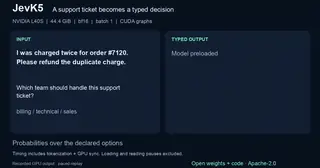 Benchmarks & researchjevk5An open-weight alternative to Jev with Apache-2.0 weights and code.GitHub · ★ 64 · allebee
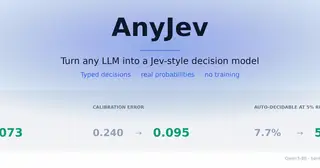 Benchmarks & researchAnyJevTurns an existing open LLM into a Jev-style decision model without training.GitHub · ★ 440 · nokia-applied-research
 SDKs & integrationssimple-jevAn open-source library that turns a Hugging Face model into a Jev-style endpoint.GitHub · ★ 507 · featherless-ai
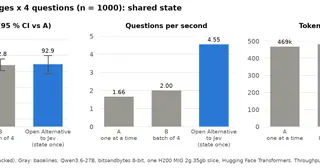 Benchmarks & researchopen-alternative-jevA research library that pulls typed choices and probability distributions from open-weight LLMs on your own GPU.GitHub · ★ 53 · ikermoel
 SDKs & integrationssys1A Rust server that gives open decision models such as Laya a System One-compatible HTTP API.GitHub · ★ 31 · alvarobartt
 SDKs & integrationsSystem One adapterTypeSafe's own MIT-licensed adapter that answers SDK calls with OpenAI, Anthropic or Gemini models instead of Jev.GitHub · ★ 296 · typesafe-ai
Questions
Is Jev open source?
No. Jev is served only through TypeSafe's hosted API. TypeSafe's SDKs, agent skill and LLM adapter are open source under MIT, but the model itself is not.
Can I download Jev's weights or run Jev locally?
Not from TypeSafe. The docs describe one hosted endpoint, and we found no weights download or self-hosting option in TypeSafe's docs or site. Local options are community models that copy Jev's interface.
What is the best open source Jev alternative?
There is no single answer. Laya has the most GitHub stars of the open decision models we list, but every project publishes its own benchmarks. Test any candidate on your own data before relying on it.
Can my existing Jev code call a local model?
Sometimes. Several community servers expose a System One-style endpoint, and TypeSafe's own system-one-adapter swaps Jev for an LLM behind the same Python response type. Check each project's docs for how complete its compatibility is.
Can I train an open model on Jev's answers?
TypeSafe's Master Customer Agreement prohibits using the service or its output for model distillation, training a model to imitate its output, or building a competing product. Read the agreement yourself before you plan anything like that.
More guides: What is Jev?Jev pricing and API costJev vs LLMs: when to use whichHow to use Jev: a quickstartJev and MCP: using Jev as a Model Context Protocol toolHow to use Jev with Claude CodeJev in an agentic harness: where it fits in an agent loopJev for orchestration: routing requests, models and skillsJev as a judge: evaluating LLM and agent outputsJev for SEO and GEOJev for ads and ad reviewJev for marketing and lead scoringCan you fine-tune Jev?Designing questions for JevWhat is RLCD?Jev statistics