Jev for ads and ad review
Jev fits advertising work that comes down to labelling or checking text: tagging ads by hook or funnel stage, flagging prohibited claims, and checking that an ad matches its landing page. TypeSafe lists these tasks among its example use cases, but Jev reads text only and does not write ads, so images need a text description and copy comes from elsewhere (Example use cases, System One).
Where Jev fits in advertising
TypeSafe's use-case map has an advertising entry: evaluating creative assets, campaign copy, landing pages and placement context; classifying brand safety and audience suitability; checking regulatory compliance and prohibited claims; and evaluating creative quality and ad-to-landing-page alignment (Example use cases). The same page lists detecting "prohibited claims" and "policy violations" under legal and compliance.
Two practical reasons it suits ad libraries: questions about one ad run in parallel in a single request (Speculative fan-out), and Jev is priced at $0.042 per million input tokens with free output (Models). That makes labelling thousands of ads affordable. See Jev pricing.
A documented pattern for ad review
TypeSafe has no ad-review cookbook, but its LLM guardrails recipe has the right shape. It asks one Noul per hazard plus a Score for severity, then code thresholds the answers to pass, review, block or route (Guardrails for LLMs). For ads, swap the hazards for your policy rules. The moderation entry describes the same idea: combine severity and confidence to allow, warn, review or block (Example use cases).
Gate on confidence, with stricter thresholds for costly mistakes. TypeSafe suggests acting automatically on high confidence, taking care in the middle, and sending low confidence to a person (Confidence). A rejected ad is cheap to fix, a live violation is not, so auto-approve only when every check is clear. More moderation examples are in Safety and guardrails.
Question designs for ads
- Noul per policy: "Does
`ad.copy`promise a specific health outcome?" and a separate Noul for each other rule. One condition per Noul (Noul). - Score, ad-to-page fit: levels from "landing page does not mention the offer" to "page makes the same offer on the same terms", each written out (Score).
- Choice, funnel stage: awareness, consideration, conversion or retention, plus
other(Primitives). - Choice, hook type: a fixed list such as problem, social proof, offer, curiosity, demonstration.
- Score, brand suitability: levels for how appropriate the placement text is for your brand.
Name the parts of the state, such as `ad.copy` or `landing_page.hero`, so each question judges the right text (Primitives).
Limits to plan for
- Text only: no image, audio or video input (Models). Transcribe video and describe visuals first.
- Jev reads instructions literally (Jev 1.13 jaggedness). Write policy rules as exact conditions, with boundary cases in the criteria.
- Prices, discounts and dates are numbers. Check "50% off" or an offer end date in code, not with the model (Jev 1.13 jaggedness).
- Ad copy is written to persuade, and content that argues for its own classification can move the answer (Jev 1.13 jaggedness). Test with tricky examples first.
- Jev does not generate ad copy (Jev with coding agents). Pair it with an LLM or a copywriter, and use Jev to check drafts.
- Calibration holds across groups of predictions, not for every single ad (System One). Keep a person on the final call for regulated categories.
Most public projects below analyse competitors' ads rather than review their own before launch. Browse more in Marketing and social, or read What is Jev? first.
Projects doing this
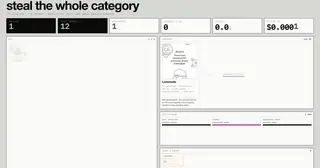 Marketing, sales & socialStealAds demoBreaks down ad hooks, offers and landing-page fit, analysing 724 live ads from 37 brands in about 40 seconds.X post · Matthew Berman
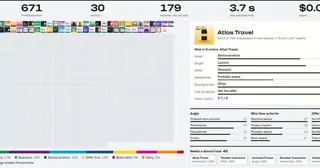 Marketing, sales & social700 live ads in 40 secondsA marketer scanned more than 700 live ads with Jev for four cents.X post · Ackerman
 Marketing, sales & social1,891 ads in 19 secondsLabels a brand's whole ad library by funnel stage and style.X post · ares
 Marketing, sales & social430 competitor ads a secondTags every live competitor ad by hook, format and survival rate.X post · zrebroia
 Marketing, sales & socialFrevana decodes a category's ads in 20 secondsDecodes 294 TikTok ads across 68 brands for about two cents.X post · FrevanaMarketing, sales & socialWinning patterns out of the Meta Ad LibraryMines long-running ads from the Meta Ad Library, filters search terms and scores landing pages.X post · Ysato
 Marketing, sales & socialA shortlist from a competitor swipe fileBreaks competitor ads down by hook, angle, offer and format.X post · keno
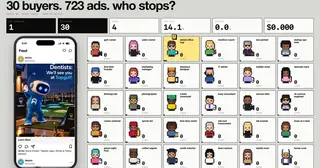 Marketing, sales & social723 ads, 30 personas, 22 centsRuns a scroll-or-stop focus group over 723 ads and 30 personas, entirely as Jev decisions.X post · Matthew Berman
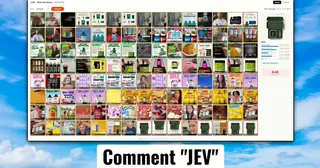 Marketing, sales & socialScoring competitor ads with Opus 5.5 and JevPairs Opus 5.5 with Jev, which makes the ad judgments.X post · raph_guilhem
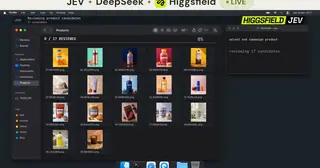 Marketing, sales & socialAd creatives from filtered assetsJev filters content and picks assets, then DeepSeek and Higgsfield turn them into ads.X post · Higgsfield AI
Questions
Can Jev write ad copy?
No. Jev does not generate text. It can tag, score and check ad copy that a person or an LLM wrote.
Can Jev review image or video ads?
Not directly. Jev accepts text only, so you need a transcript or a text description of the creative first. Its judgment is only as good as that description.
Can Jev replace a platform policy review?
No. It can pre-screen ads against rules you write and flag likely problems, but ad platforms apply their own review. Treat Jev as an early check, not a guarantee of approval.
How do I handle ads Jev is unsure about?
Use the confidence value on Choice and Score answers, or a band of Noul values, to send unsure cases to a person. TypeSafe recommends stricter thresholds where mistakes cost more.
Is Jev fast enough for a large ad library?
TypeSafe says most queries complete in about 100 ms, and every question about one ad can go in a single request. Rate limits apply per account and can change.
More guides: What is Jev?Jev pricing and API costJev vs LLMs: when to use whichHow to use Jev: a quickstartJev and MCP: using Jev as a Model Context Protocol toolHow to use Jev with Claude CodeJev in an agentic harness: where it fits in an agent loopJev for orchestration: routing requests, models and skillsJev as a judge: evaluating LLM and agent outputsJev for SEO and GEOJev for marketing and lead scoringIs there an open source Jev?Can you fine-tune Jev?Designing questions for JevWhat is RLCD?Jev statistics